Population Model (GWTC-4): FullPop-4.0#
Primary Mass Distribution
The figure below shows the one-dimensional FullPop-4.0 mass distribution \(p(m|\lambda)\) for the primary black hole mass in the range \([1, 100]\,M_\odot\). The model combines a broken power law with two Gaussian peaks and includes two characteristic features: the neutron star–black hole mass gap (between \(M^\mathrm{gap}_\mathrm{low}\) and \(M^\mathrm{gap}_\mathrm{high}\)), and the pair-instability gap (between \(M_\mathrm{PI,low}\) and \(M_\mathrm{PI,high}\)).
where \(l(m \mid m_{\text{max}}, \eta)\) is the low-pass filter with power-law \(\eta\) applied at mass \(m_{\text{max}}\), \(n(m \mid \gamma_{\text{low}}, \gamma_{\text{high}}, A)\) is the notch filter with depth \(A\) applied between \(\gamma_{\text{low}}\) and \(\gamma_{\text{high}}\), and \(\lambda\) is the subset of hyperparameters \(\{\gamma_{\text{low}}, \gamma_{\text{high}}, A, \alpha_1, \alpha_2, m_{\min}, m_{\text{max}}\}\).
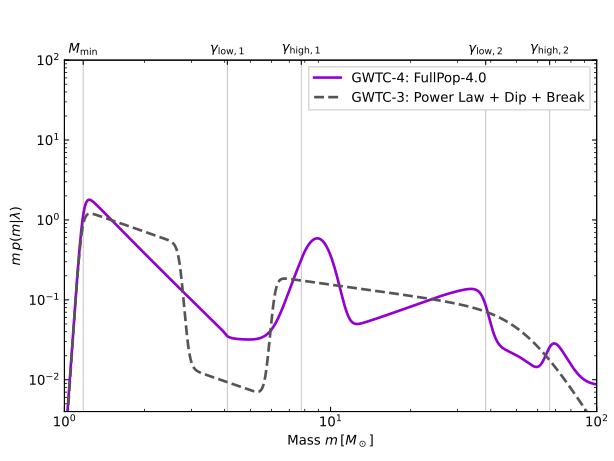
Population model for the primary mass distribution.#
Hyperparameters Value
Parameter |
Description |
Posterior Value |
|---|---|---|
Mass Distribution |
||
\(m_{\mathrm{min,NS}}\) |
Minimum neutron star mass (\(M_\odot\)) |
1.18 |
\(m_{\mathrm{max,NS}} \equiv \gamma_{\mathrm{low},1}\) |
Maximum neutron star mass (\(M_\odot\)) |
4.09 |
\(m_{\mathrm{min,BH}} \equiv \gamma_{\mathrm{high},1}\) |
Minimum black hole mass (\(M_\odot\)) |
7.76 |
\(\gamma_{\mathrm{low},2}\) |
Lower boundary of pair-instability gap (\(M_\odot\)) |
38.3 |
\(\gamma_{\mathrm{high},2}\) |
Upper boundary of pair-instability gap (\(M_\odot\)) |
66.58 |
\(m_{\mathrm{max,BH}}\) |
Maximum black hole mass (\(M_\odot\)) |
152 |
\(\alpha_1\) |
Power-law exponent for masses below \(m_{\mathrm{max,NS}}\) |
−4.51 |
\(\alpha_{\mathrm{dip}}\) |
Power-law exponent within the NS–BH mass gap |
−1.68 |
\(\alpha_2\) |
Power-law exponent for masses above \(m_{\mathrm{min,BH}}\) |
−0.902 |
\(\mu_{\mathrm{peak},1}\) |
Mean of primary Gaussian peak (\(M_\odot\)) |
37.81 |
\(\sigma_{\mathrm{peak},1}\) |
Std. dev. of primary Gaussian peak (\(M_\odot\)) |
17.13 |
\(c_1\) |
Mixing fraction of primary Gaussian peak |
735.47 |
\(\mu_{\mathrm{peak},2}\) |
Mean of secondary Gaussian peak (\(M_\odot\)) |
8.9 |
\(\sigma_{\mathrm{peak},2}\) |
Std. dev. of secondary Gaussian peak (\(M_\odot\)) |
1.04 |
\(c_2\) |
Mixing fraction of secondary Gaussian peak |
211.73 |
\(A_1\) |
Depth of primary mass gap suppression |
0.0915 |
\(A_2\) |
Depth of pair-instability gap suppression |
0.828 |
\(\eta_0\) |
Sharpness of low-mass truncation |
50 |
\(\eta_1\) |
Sharpness at \(m_{\mathrm{max,NS}}\) |
50 |
\(\eta_2\) |
Sharpness at \(m_{\mathrm{min,BH}}\) |
50 |
\(\eta_3\) |
Sharpness at \(\gamma_{\mathrm{low},2}\) |
30 |
\(\eta_4\) |
Sharpness at \(\gamma_{\mathrm{high},2}\) |
30 |
\(\eta_5\) |
Sharpness of high-mass truncation |
10 |
Pairing Function |
||
\(m_{\mathrm{break}}\) |
Pairing function break mass (\(M_\odot\)) |
5.0 |
\(\beta_1\) |
Pairing power-law index for \(m_2 < m_{\mathrm{break}}\) |
0.964 |
\(\beta_2\) |
Pairing power-law index for \(m_2 \geq m_{\mathrm{break}}\) |
2.16 |
Spin Distribution |
||
\(\mu_{\chi}\) |
Mean of spin magnitude Gaussian component |
0.0137 |
\(\sigma_{\chi}\) |
Std. dev. of spin magnitude Gaussian component |
0.31 |
\(a_{\mathrm{max}}\) |
Maximum spin magnitude |
1 |
\(\xi_{\mathrm{spin}}\) |
Fraction of BHs in preferentially aligned component |
0.713 |
\(\sigma_{\mathrm{spin}}\) |
Width of preferentially aligned component |
0.56 |